
Tricolor: The Road to Ruin
February 2026


On September 10, 2025, Tricolor Holdings, LLC (“Tricolor” or the “Company”), a subprime auto lender and used car dealer, filed for Chapter 7 in the U.S. Bankruptcy Court for the Northern District of Texas. The sudden move left creditors reeling, with expected exposures for larger creditors like JP Morgan, Fifth Third Bank, and Barclays reportedly in the half-billion-dollar range.
Followed just two weeks later by the Chapter 11 filings of First Brands Group, LLC and its affiliates (collectively, “First Brands”), another large player in the automobile sector, the Tricolor bankruptcy has left many to wonder whether this may be the first sign of a deeper issue within the automobile industry and/or with opaque financing structures arranged in the private credit market.



On September 10, 2025, Tricolor Holdings, LLC (“Tricolor” or the “Company”), a subprime auto lender and used car dealer, filed for Chapter 7 in the U.S. Bankruptcy Court for the Northern District of Texas. The sudden move left creditors reeling, with expected exposures for larger creditors like JP Morgan, Fifth Third Bank, and Barclays reportedly in the half-billion-dollar range.
Followed just two weeks later by the Chapter 11 filings of First Brands Group, LLC and its affiliates (collectively, “First Brands”), another large player in the automobile sector, the Tricolor bankruptcy has left many to wonder whether this may be the first sign of a deeper issue within the automobile industry and/or with opaque financing structures arranged in the private credit market.




Background: An Overnight Collapse
Established in 2007, Tricolor was an auto lender and used car dealer operating throughout the U.S. Southwest, California, and Illinois. Before its filing, Tricolor served as the third-largest used auto retailer in Texas and California. As a U.S. Department of the Treasury certified Community Development Financial Institution (“CDFI”), Tricolor specialized in providing affordable loans to individuals with little-or-no credit history. By June 2025, Tricolor had disbursed over $5bn in auto loans as part of its mission “to empower underserved Hispanics and provide them a path to a better future through both physical and upward financial mobility.”1
Background: An Overnight Collapse
Established in 2007, Tricolor was an auto lender and used car dealer operating throughout the U.S. Southwest, California, and Illinois. Before its filing, Tricolor served as the third-largest used auto retailer in Texas and California. As a U.S. Department of the Treasury certified Community Development Financial Institution (“CDFI”), Tricolor specialized in providing affordable loans to individuals with little-or-no credit history. By June 2025, Tricolor had disbursed over $5bn in auto loans as part of its mission “to empower underserved Hispanics and provide them a path to a better future through both physical and upward financial mobility.”1
To finance its operations, Tricolor used a multi-step financing plan under which it (1) funded acquisitions of automobile inventory through floorplan financing and refurbished the vehicles acquired at its two reconditioning facilities; (2) used warehouse financing to then fund auto loans for vehicles purchased by customers; (3) issued asset-backed securities using pools of those same auto loans; and (4) utilized proceeds from these securitizations to repay outstanding debt under its warehouse facilities, thus ensuring continued operations and liquidity2.
Tricolor Multi-Step
Financing Plan

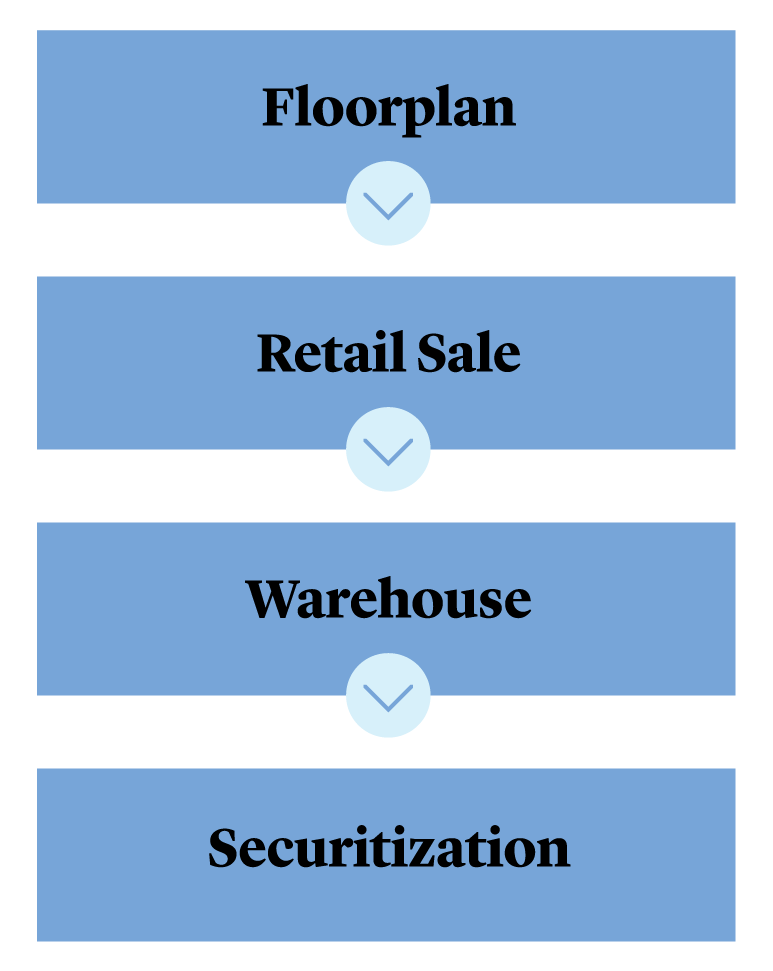
Source: Trustee’s October 3, 2025 Demonstrative Exhibit.
To finance its operations, Tricolor used a multi-step financing plan under which it (1) funded acquisitions of automobile inventory through floorplan financing and refurbished the vehicles acquired at its two reconditioning facilities; (2) used warehouse financing to then fund auto loans for vehicles purchased by customers; (3) issued asset-backed securities using pools of those same auto loans; and (4) utilized proceeds from these securitizations to repay outstanding debt under its warehouse facilities, thus ensuring continued operations and liquidity2.
Tricolor Multi-Step
Financing Plan
Source: Trustee’s October 3, 2025 Demonstrative Exhibit.




Just three months after Tricolor completed its 17th asset-backed securitization transaction in June 20253, the Company collapsed seemingly overnight. On September 5, 2025, the Company furloughed all of its employees4. That same day, JP Morgan, one of the Company’s warehouse lenders, delivered a notice of servicer termination5. This was quickly followed by additional notices of servicer termination and disclosures by warehouse lenders regarding exposure to potential fraud connected with Tricolor. By September 10, 2025, Tricolor and 17 of its subsidiaries had filed for Chapter 7 in the Northern District of Texas.
In a move uncharacteristic for a company of its size, Tricolor opted to liquidate its assets in Chapter 7, rather than seek reorganization under Chapter 11. Although details about Tricolor’s finances remain murky, the Chapter 7 trustee reported $1.9bn in secured debt involving approximately twenty lenders6. Reportedly, JP Morgan7, Fifth Third Bank8, and Barclays9 collectively face losses of half a billion dollars on warehouse loans made to Tricolor.
Although the exact cause of Tricolor’s collapse is still unknown, allegations regarding systemic fraud, such as the “double-pledging” of loans across multiple lenders and the duplication of vehicle identity numbers to generate multiple loans per vehicle, are under investigation by the U.S. Department of Justice10. Additional red flags include poor underwriting, weak governance, as many of Tricolor’s processes were managed in-house, and opaque financing.


Implications for the Private Credit Market
With the collapse of First Brands just two weeks after Tricolor’s own bankruptcy filing, investors have been scrambling to understand whether the two breakdowns are isolated incidents involving fraud or omens of something worse to come.
A Timeline of Tricolor’s Collapse
Hover to find out more
Implications for the Private Credit Market
With the collapse of First Brands just two weeks after Tricolor’s own bankruptcy filing, investors have been scrambling to understand whether the two breakdowns are isolated incidents involving fraud or omens of something worse to come.
A Timeline of Tricolor’s Collapse
Click to find out more




In a recent report published on November 7, 2025, the Federal Reserve Board characterized the bankruptcies as “isolated incidents” that highlighted the kinds of losses that could “arise from opaque off-balance-sheet funding arrangements that may be used by certain privately held firms.”18 The Structured Finance Association similarly stated that the Tricolor bankruptcy was better attributed to the unique instances of fraud, than to any flaws in the securitization mechanism19.
Despite these assurances, the collapse of two large companies within the same industry that were both accessing capital from private sources, within such a short span of time, begs the question of whether the incidents really are isolated. This fear is reflected in a recent letter by Senators Elizabeth Warren (D-Mass.) and Jack Reed (D-R.I.) to U.S. banking regulators, urging them to take “immediate action to ensure the resilience of the banking system as cracks emerge in credit markets, especially private credit markets.”20 The letter, which draws on the Tricolor and First Brands bankruptcies as support for its argument, also highlights potential similarities between current circumstances (i.e., loose underwriting and excessive risk-taking in the subprime market) and the 2008 financial crisis.

While only time will tell whether the Tricolor and First Brand bankruptcies are truly isolated incidents or reflect systemic issues within certain segments of the private credit market, such as warehouse financing, concerned investors should monitor both bankruptcies for additional insight regarding the causes behind each’s collapse.



 Built with Shorthand